Search Findability, Gap Coverage & Semantic Search Engineering

Our flagship practice: we test your live search box against real multi-constraint shopper requests, quantify the sales you miss, and engineer the hybrid retrieval and catalog fix.

Field Evidence · Anonymized Store Audits

Shoppers type constraints and needs, not SKU titles

On October 31, 2026 we tested two US furniture retailers against their own in-stock catalogs. Furniture retailer A (Fast Simon) failed 10 of 22 requests (9 returning zero results). Furniture retailer B (Algolia) failed 7 of 24, with 9 more only partly right.

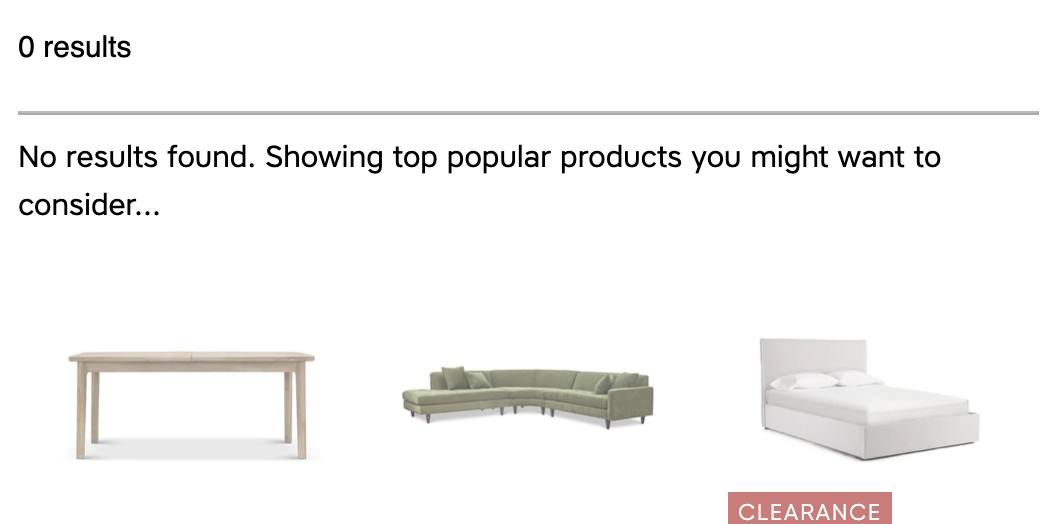
0 results
A furniture store’s search results page reading “No results found” for “tv stand for 75 inch tv”, followed by unrelated popular products.
Furniture retailer A, October 31, 2026. 10 media stands 67 inches or wider were in stock. Talos extracts width (≥ 67") and category (Media Console) from prose, returning 10 fitting in-stock TV stands in <90ms.
Wrong products
Search results for a round glass table for six showing rectangular wooden dining sets and outdoor sets.
Furniture retailer B, October 31, 2026. Rectangular wooden sets for a round glass table for 6.

What We Test & Engineer

Seven constraint types where keyword search breaks

A standard Search Audit tests 30 frozen shopper intents (60–80 in Extended) across size/fit, price ceilings, materials, use-cases, seating/capacity, negation, and multi-constraint combinations. Read Method A in the Test Standard.

Constraint types with example intents
ConstraintExample intentA correct answer must respect
Size or fittv stand for 75 inch tvStand width at or above the TV’s width
Priceoak desk under $500Price at or below $500 on the test date
Materialsolid wood dining tableMaterial attribute or stated construction
Use or audiencecouch good for kids and dogsPerformance or pet-friendly fabric
Capacitydining table that seats 8Stated seating, or a length that fits 8
Negationsofa that isn’t leatherExcludes leather while keeping matching sofas
Combinationgrey sofa under 80 inches for a dogAll constraints satisfied simultaneously

From Audit to Production Fix

Five steps from ground-truth diagnosis to hybrid semantic search

Every result is verified against your catalog truth table, and 100% of your Advisory Audit fee is credited toward your Tier 2 build within 60 days.

  1. Run each intent

    In your search box on desktop and mobile, logged out, in a clean session, from a US IP address. We record results, autocomplete, and any “did you mean”.

  2. Capture evidence

    A timestamped full-page screenshot, the result list as text (product, price, position) and the URL, named by intent and run time.

  3. Adjudicate by hand

    A reviewer marks each of the top 10 results against your catalog truth table. A second reviewer checks every failure and a 20% sample of passes.

  4. Classify & diagnose

    Good: fitting product in top 3. Partly right: fitting items below #3 or one constraint ignored. Failed: zero results or no match in top 10 while stocked.

  5. Engineer the fix

    We deliver a vendor-neutral engineering spec—or implement the fix directly via in-stack tuning or our Talos hybrid semantic search layer.

Audit Deliverables & Live Reference Engine

Hard metrics plus a live Talos Semantic Engine proof-of-concept

Every failure includes timestamped evidence, the exact in-stock SKUs that should have matched, and a side-by-side comparison against our Talos Semantic Engine (live at usafurnish.com). See the sample audit report.

  • Shopify Search & Discovery
  • Algolia
  • Fast Simon
  • Klevu
  • Searchspring
  • Constructor
  • Bloomreach
  • Elasticsearch / OpenSearch
  • Vespa
  • Talos Semantic Engine
Failure rate
Failed intents divided by intents with a match in the catalog
Zero-result rate
Intents returning nothing, with how many had a match in the catalog
Precision at 3 and at 10
Share of the top 3 and top 10 results that are relevant
Constraint handling
Pass rate by constraint type: size, price, material, use, capacity, negation
First fitting position
Position of the first relevant product, median across intents
Missed-sale rate and revenue-at-risk range
On-site only, stated as a range with its assumptions

Tier 1 & Tier 2 Search Pricing

Audit first, then credit 100% toward the engineering build

Want AI shopping assistants tested on the same intent set? Combined Search & AI Findability Audit covers both for $5,000 / $10,000. $2,500 design-partner rate available for the first 3 Tier 1 Search Audits in exchange for named before/after case study rights.

Flagship

Search Findability & Gap Coverage Audit

Tier 1 Diagnostic · 100% credited to Tier 2 within 60 days

$3,500
Standard · 2 weeks30 shopper intents on your search box (desktop & mobile), human-verified catalog truth table, up to 2,500 SKUs
$7,500
Extended · 3 weeks60–80 intents, 2–3 competitor search boxes, search-log analysis, up to 25,000 SKUs or 3 storefronts

Tier 2 Fixed-Scope Search Builds

Engineer the Search & Catalog Fix

In Advisory mode, 100% of your Tier 1 Audit fee is credited toward any Tier 2 engineering build signed within 60 days of the readout.

$6,000–$12,000
Semantic & Hybrid Search Build (In-Stack Advisory)In-stack tuning of Algolia, Klevu, Constructor, Fast Simon or Shopify Search (attribute indexing, constraint rules, synonyms) + before/after re-test. 3–4 weeks.
$12,000–$35,000 build (+ $1,500–$3,500/mo hosted)
Semantic & Hybrid Search Build (Turnkey / Talos Layer)Turnkey hybrid BM25 + dense vector + constraint parser & cross-encoder reranker (or hosted Talos Semantic Engine layer); includes before/after re-test.
$6,000–$18,000
Catalog Enrichment & AI Feed FixAutomated + human-QA attribute extraction from prose/images into structured fields, schema.org/Product JSON-LD, and Merchant Center / Shopify Catalog feeds. 3–6 weeks.
$8,000–$18,000
Evaluation Harness & Experimentation SetupGolden query/intent sets (200–1,000 queries), automated NDCG@10 / MRR / Constraint Recall CI suite, LLM-as-judge calibration, and A/B interleaving setup. 2–4 weeks.

Full 4-tier price list · Event-triggered re-test $1,500

What are the misses costing you?

An estimate for on-site search only, with every assumption shown. 35% is our cautious default failure rate on natural-language searches; a Search Audit measures yours.

million
Our furniture study measured 45% on 22 natural-language requests; 35% is a cautious default.
Adjust the other assumptions (optional)
%
Leave blank for our assumption, 20%. Growing and AI-era use 35% and 50%, or yours if it is higher.
%
Leave blank for the benchmark, 44%.

Estimated revenue at risk a year

$163Ktoday (likely)

Today
$163K
20% of searches in natural language, 7% fail
Growing
$286K
35% of searches in natural language, 12.2% fail
AI-era
$408K
50% of searches in natural language, 17.5% fail

Recoverable if we close a quarter of today’s gap: $41K a year, about $3,400 a month.

How it’s calculated. Online revenue × 44% from shoppers who search × the share of searches written in natural language (20% today) × the failure rate on those searches (35%, a cautious default, below the 45% our furniture study measured) × 53% of shoppers who leave after a failed search. Growing and AI-era use the same failure rate. Recoverable is 25% of the Today case, our planning assumption until a fix is measured.

Sources: 44%, Constructor, 609M searches on 113 sites, Q4 2024 (vendor data); 53%, Google Cloud and Harris Poll, 2022 (stated behaviour). The 45% failure rate is from our furniture study of 22 natural-language requests and applies only to natural-language searches. The natural-language shares, the 35% default and the 25% recovery are our assumptions; the loss grows as more shoppers search in natural language and through AI assistants. These are estimates, not forecasts.

Search engineering questions

How is the Search Findability Audit different from the free 60-second Findability Score? The free Findability Score runs 8 automated requests and gives an immediate 0–100 diagnostic across 4 engineering sub-scores. The Search Findability Audit ($3,500 Standard / $7,500 Extended) runs 30 to 80 real shopper intents on desktop and mobile, checks the top 10 results of each by hand against your catalog truth table, analyzes your search logs, and delivers a root-cause engineering spec—with 100% of the fee credited toward a Tier 2 build within 60 days.

Do we have to replace our current search engine? No. In Path A ($6,000–$12,000), we tune and re-index your existing engine (Algolia, Klevu, Constructor, Fast Simon, or Shopify Search) and enrich your catalog attributes ($6,000–$18,000). In Path B ($12,000–$35,000 build (+ $1,500–$3,500/mo hosted)), we deploy our turnkey Talos Semantic Engine hybrid retrieval and reranking layer on top of your catalog.

Is there a design-partner discount for the first Search Audits? Yes. $2,500 design-partner rate available for the first 3 Tier 1 Search Audits in exchange for named before/after case study rights.

Can we see your semantic search engine running live? Yes. Our Talos Semantic Engine is live across 10,000+ furniture SKUs at usafurnish.com, demonstrating sub-120ms hybrid BM25 + vector retrieval, numeric/size constraint parsing, and cross-encoder reranking.

Next Step · Engineering Architecture & Diagnostics

Find out what your shoppers can’t find.

A 30-minute engineering call: your store, your search & recsys stack, and whether a Tier 1 Audit, Tier 2 Build, or Resident ML Engineer fits best. No slides, no obligation.